

Location
Nevada
Ownership
100%
Project Stage
Brownfields Discovery and Re-Exploration
Metals
Gold & Silver
Property Size
~4,275 acre (100% control)
Deposit Type
Epithermal vein district
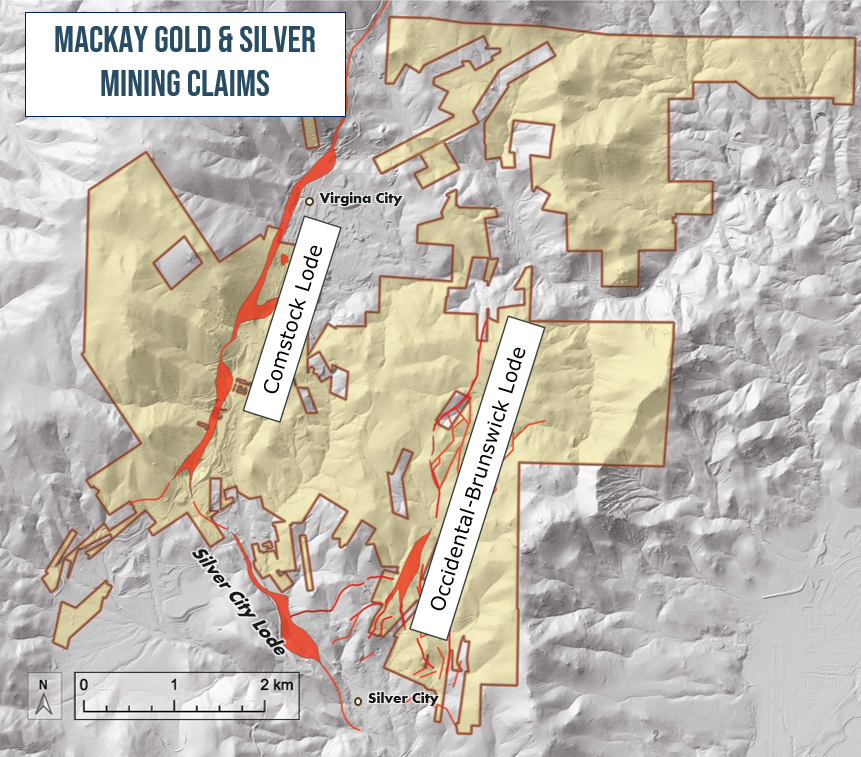
Despite its rich history, large sections of the Comstock District have seen virtually no exploration for over 100 years because of small, highly fragmented mining properties and ownership. Recent land consolidation by Mackay, which has unified a single large and contiguous land package under Mackay control, has removed this barrier to exploration.
Mackay now controls more than 7 km of strike of the District’s two major parallel vein structures – the Comstock Lode and Occidental–Brunswick Lode. A systematic, multi-platform, modern exploration strategy has been developed to target high-grade near-surface oxide opportunities, historically defined underground resources, and new bonanzas at depth.
Geology
The Comstock District sits at the northern end of the highly productive Walker Lane gold belt. The Walker Lane is a 100-km wide by 500-km long, northwest-trending structural corridor extending from Reno towards Las Vegas along the Nevada-California border, renowned as a prolific, high-grade, epithermal, and intrusive-related mineral district. It has produced over 50 million ounces of gold and 700 million ounces of silver, with major deposits and mines that include Round Mountain, Silicon and the Comstock Lode.
Geology of the Comstock District consists of Tertiary volcanic tuffs and flows of andesite and rhyolite composition that overlie an older sequence of Mesozoic metasedimentary rocks and granite. Extensional basin-and-range tectonism produced northwest-to-northeast-trending faults that became the sites of hydrothermal fluid flow and epithermal quartz-carbonate vein formation. These veins, rich in gold and silver, comprise the veins or lodes of the Comstock District.
The silver-gold deposits at Comstock are categorized as classic low-sulfidation epithermal style mineralization, the same style responsible for many of the world’s most profitable precious-metal camps. Mineralization occurs in networks of quartz-rich veins, stockworks, and breccias developed along major fault zones. Historically, extremely rich “bonanza” zones were found where veins intersected or flexed, producing some of the highest-grade gold and silver ever mined in the American West. The majority of the district has received limited modern exploration, and today, many areas, continue to offer strong potential for new discoveries, including the Occidental-Brunswick Lode that is the near-term focus of Mackay Gold & Silver’s exploration efforts.


